
NerdOctaxe review: 8 BM1370 chips on a desk
The NerdOctaxe takes the Bitaxe and NerdQAxe idea further: eight BM1370 chips, close to 10 TH/s, in a machine built for home mining. I unboxed it, set it up and measured it. The real question: does it make sense against two small machines?
Published 24 September 2026 · by Pixel
Machine sent by MineShop, a partner of the channel. The measurements are my own, taken with a wall meter. My partner code is in Support.
VideoThe review on video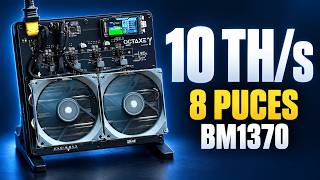 I tested the NerdOCTAXE: 8 BM1370 chips for home Bitcoin miningOn YouTube, in French with subtitles
Spec sheet
8 × BM1370 (the S21 Pro generation)9.6 to 9.7 TH/s, stable144 to 146 W, stock settingsabout 15 J/THchips 60 to 65 °C, regulators 45 to 55 °C2 large heatsinks, 2 low-profile fansWi-Fi only, no Ethernetmodified AxeOS, open sourceautomotive-style fuse, replaceable€600 to €650- Close to 10 TH/s in a single machine, stable out of the box.
- Open-source software, in the Bitaxe tradition.
- Replaceable fuse: if something goes wrong, the fuse blows, not the board.
- Temperatures under control, noise manageable in an office.
- The price: €600 to €650.
- For the same budget, several small machines spread the risk better.
- Overclocking discouraged on my version.
- Wi-Fi only.
In the box
The main block arrives assembled: a large board with the 8 chips, two big heatsinks and two low-profile fans. With it: a 12 V power supply sized for the load with a high-current connector, a stand, a short manual and plug adapters.
What strikes you is the size and density: it feels like holding two NerdQAxes glued together. On the front, the usual AxeOS screen shows hashrate, chip and regulator temperatures, the IP address and the pool connection status.
A clever detail: the fuse
The board is protected by an automotive-style fuse. In case of overload or a serious fault, it takes the hit before anything else, and it is easy to replace. Much better than frying the whole board.
Setup
Same as the rest of the family: when powered, the NerdOctaxe creates its own Wi-Fi network. Join it from a phone or computer, a setup page opens, and you enter your Wi-Fi, the pool (or node) address and your Bitcoin address as the user. The walkthrough is the same as for a Bitaxe.
Measurements
9.6 to 9.7 TH/s, stable after about ten minutes144 to 146 W, stock settingsabout 15 J/TH60 to 65 °C45 to 55 °CThe screen and the AxeOS dashboard agree on the hashrate. Noise-wise, you can hear it, but it stays manageable in an office or living room: no need to hide it in the garage.
Who is it for?
As always, this is not a machine built for profit. The point is to learn, take part in the network and have a real chance of finding a block one day: about 1 in 1,800 per year solo, with the network as of 24 September 2026.
The main drawback is the price: €600 to €650. For that budget you can buy several small machines to spread the risk, or look at more industrial mini machines that offer more TH/s per euro but without the open-source side. To discover home mining, I would rather start with a Bitaxe Gamma or a plain NerdQAxe: Which miner for home mining?
What about overclocking?
It could reportedly be pushed to around 12 TH/s, even 15 with liquid cooling. But that is strongly discouraged on my version of the machine, and given its price, I am not taking the risk.
My verdict
If you are an enthusiast with the budget and you enjoy collecting this kind of hardware, it is an interesting machine: close to 10 TH/s, open source, well built. To start out, two small machines remain the more sensible choice.
Other reviews
- Thor X1 review: the first BM1373 chip at homeThe best efficiency I have measured on a desk miner, with closed software.
- NerdQAxe++ Hydro review: the water-cooled mini minerFour chips, pre-assembled liquid cooling, and office-level noise.