HOME BITCOIN MINING · SINCE 2017
I mine Bitcoin at home. I built my own pool, coded my own tools, and I publish everything.
- What it computes
- 0.00TH/s
- What it draws
- 00W
- What it costs per month
- ≈ 0.00€
- A block roughly every
- ~00min
- If that one lands here
- 0.000BTC
- Bitcoin blocks found
- None
Over 80 videos, in French
Test benches for the hardware I actually buy, step-by-step setup guides and longer pieces on mining centralisation. It is where I spend most of my time, and probably the best place to start. Videos are in French, with subtitles.


MY POOL · PUBLIC SINCE JULY 2025 · 0 % FEE
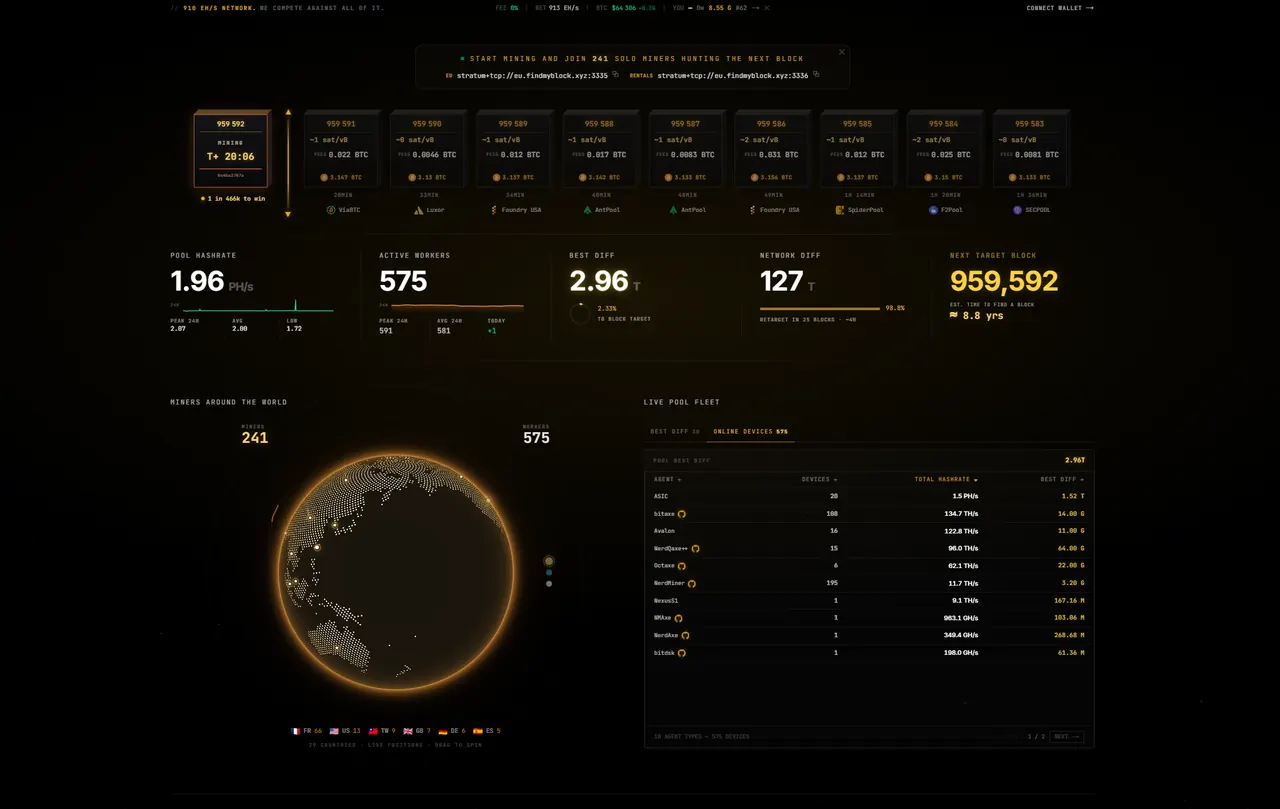
FindMyBlock, mining with no middleman
It started as my own private pool: I wanted to mine on infrastructure I controlled rather than someone else's. I opened it to the public in July 2025 with a bigger idea in mind, which is to make solo mining simple enough that it becomes a way into understanding Bitcoin.
- POOL HASHRATE
- ·
- MINERS ONLINE
- ·
- BEST SHARE
- ·
Works with Bitaxe, NerdQaxe, Avalon Nano and anything that speaks Stratum.
How it works under the hood
FindMyBlock is not open source. Its core comes from Public Pool, Benjamin Wilson's free software project. That code is non custodial: the pool never holds your bitcoin, every machine mines straight to the chain, and if a block lands the reward goes to your address without ever passing through me. Only mining on your own node is safer.
Over a year of development, additions every month, and a great deal of feedback from the community that helps me improve it.
MY APP · BETA · MIT LICENCE
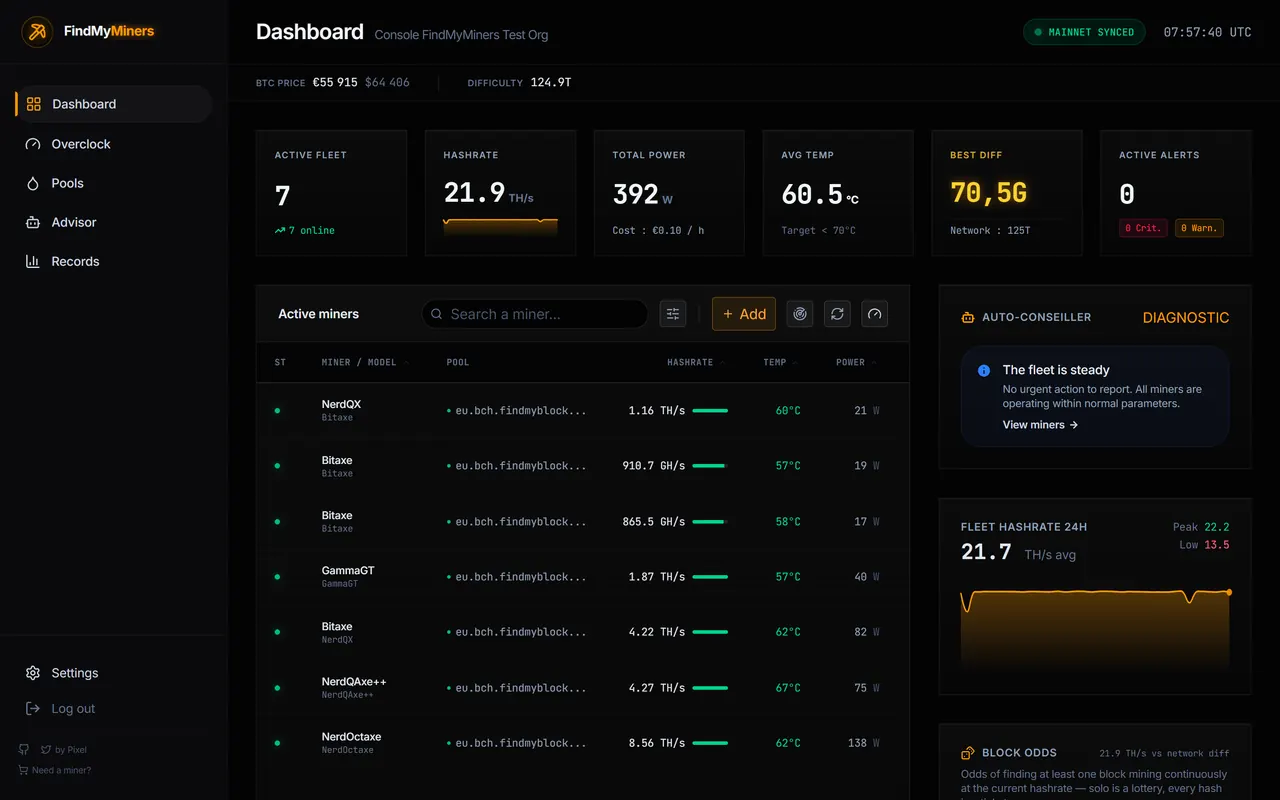
FindMyMiners, your whole fleet on one screen
As the machines piled up, I found myself juggling ten browser tabs. So I coded the dashboard I was missing. It runs on your own machine, never in the cloud, and the code is open.
- Automatic discovery of every miner on your local network.
- Remote control: frequency, voltage, fan speed, reboot.
- Discord alerts when a machine drops out or overheats.
- A diagnostics module that tells you which machine to check first.
Three things I wish someone had explained to me
I am not an engineer, and I am still learning. Here is what I have pieced together from reading, taking things apart and getting it wrong, told the way I would have wanted to read it at the start.
Mining is guessing, very fast
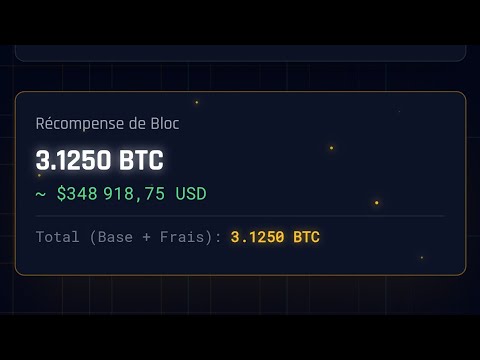
Roughly every ten minutes, the network looks for a number. Millions of machines guess at random, billions of times per second. The first one to land on it writes the next block and receives 3.125 bitcoin. Cheating is impossible: you have to genuinely spend electricity.
Solo means all or nothing
In a normal pool, thousands of miners share their power and split small regular payouts. Solo means playing alone: the reward is whole, or nothing. In practice it is nothing, and that can last for years.
Every machine tips the scale a little
Today six pools produce more than 80 % of all blocks. Every independent miner that switches on is one more participant nobody controls. That motivates me far more than any hope of the jackpot.
Nine years of learning, and one board that changed everything
None of this was planned. Every step came from a question I could not answer with what already existed.
-
2017
I start with a graphics card
I started like a lot of people: a GPU running overnight and some CPU mining to get the idea. Not Bitcoin yet, the dedicated machines cost far too much.
- ₿
THE TURNING POINT 2023
The Bitaxe: mining Bitcoin at home becomes possible
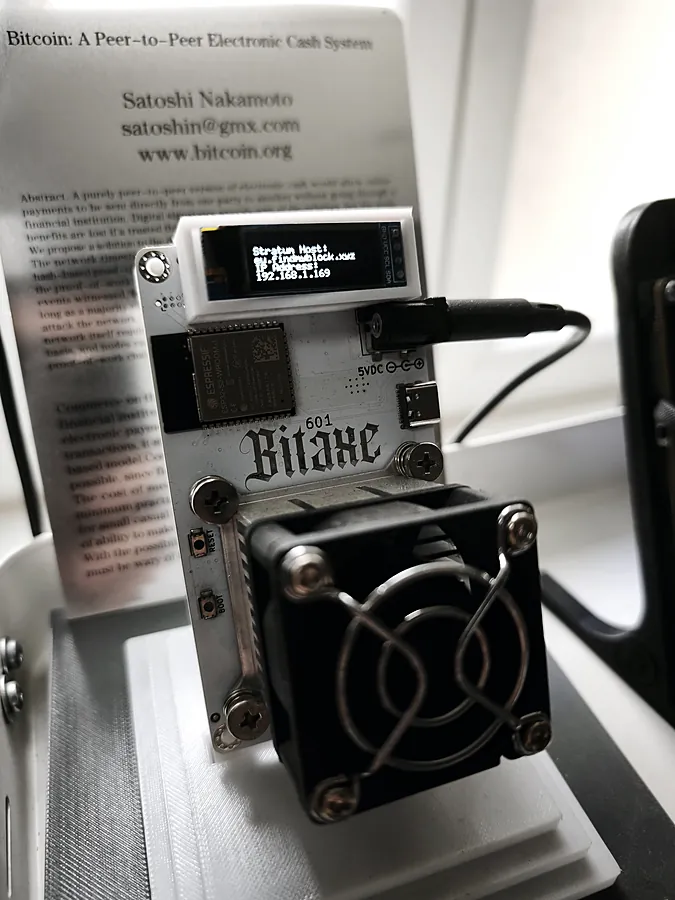
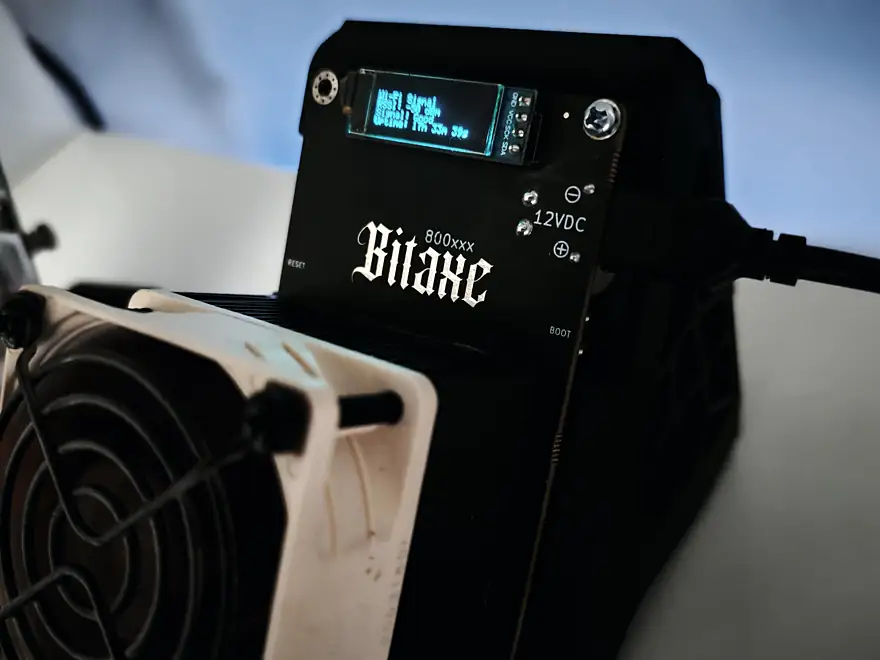
A fully open source board, the same chip as the industrial machines, 15 watts, sitting on a desk. For the first time I could mine Bitcoin myself, with no farm and no middleman. Everything that follows starts with this board.
-
2024
My own Bitcoin node
Mining on someone else's pool still means delegating part of your trust. I set up a full node at home so I could validate transactions myself.
-
2025
FindMyBlock, my solo pool
With the node in place, I built my own solo pool, at first just for myself. Opened to everyone in July 2025.
-
2026
FindMyMiners, to run the fleet
As I kept adding machines, I needed a way to watch them without opening ten tabs. I coded it, then released it as free software.
Why I keep going even though it costs me money
On paper I should switch it all off. Electricity costs more than the machine earns, and the odds of finding a block are so small they stop meaning anything. Every calculator says the same thing.
But solo mining is not measured like an investment. The heat is not wasted: it warms the room in winter. The node is not pointless: it is a piece of the network nobody can censor. And the lottery ticket, however tiny, has no middleman attached to it.
And a build that fails teaches me more than ten articles. If telling the story saves one person from frying a board, the time already paid for itself.
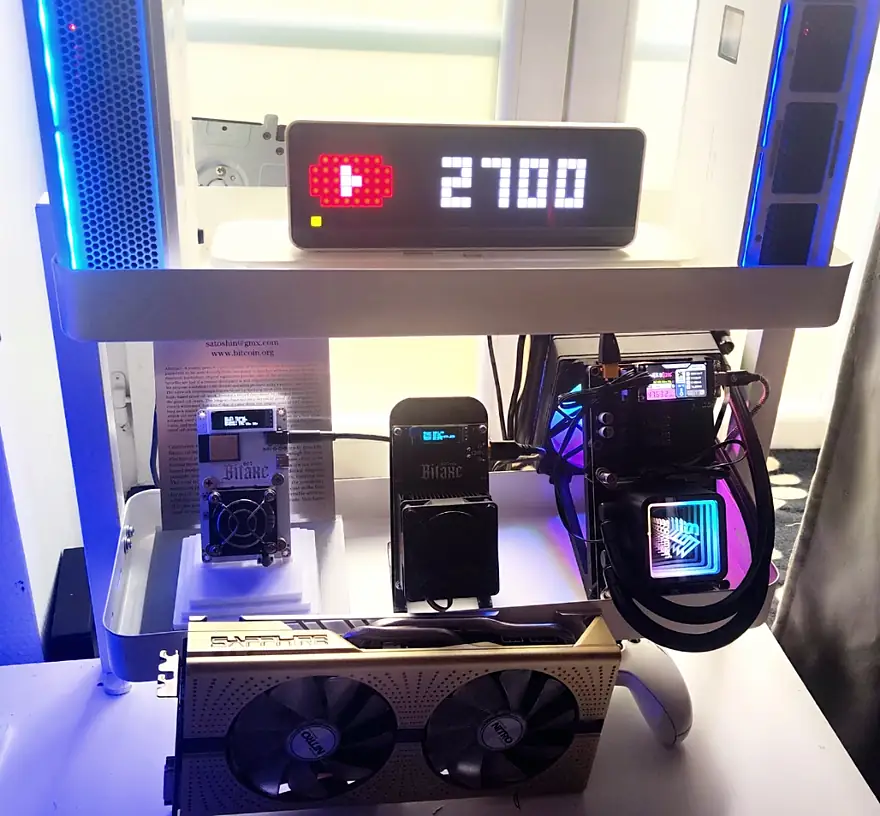
- Main machine
- NerdQaxe++
- Test machine
- Bitaxe Gamma 601
- Pool
- FindMyBlock (mine)
- 3D printer
- Elegoo Centauri Carbon
- Current project
- Gamma cooling tower
- Code licence
- MIT
- Training
- Self-taught
- Bitcoin blocks found
- Not yet
- Returns promised
- None
What actually runs at my place
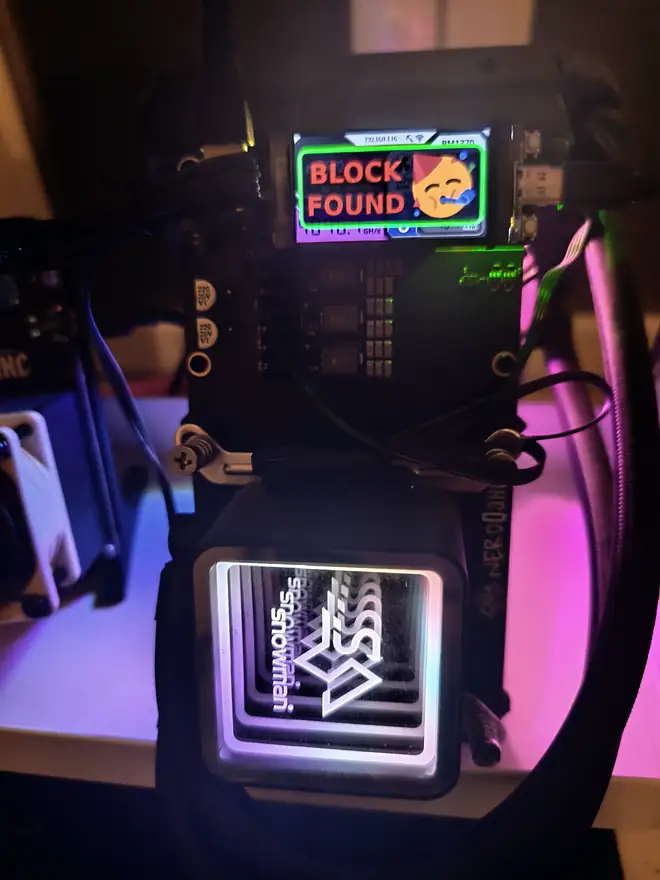
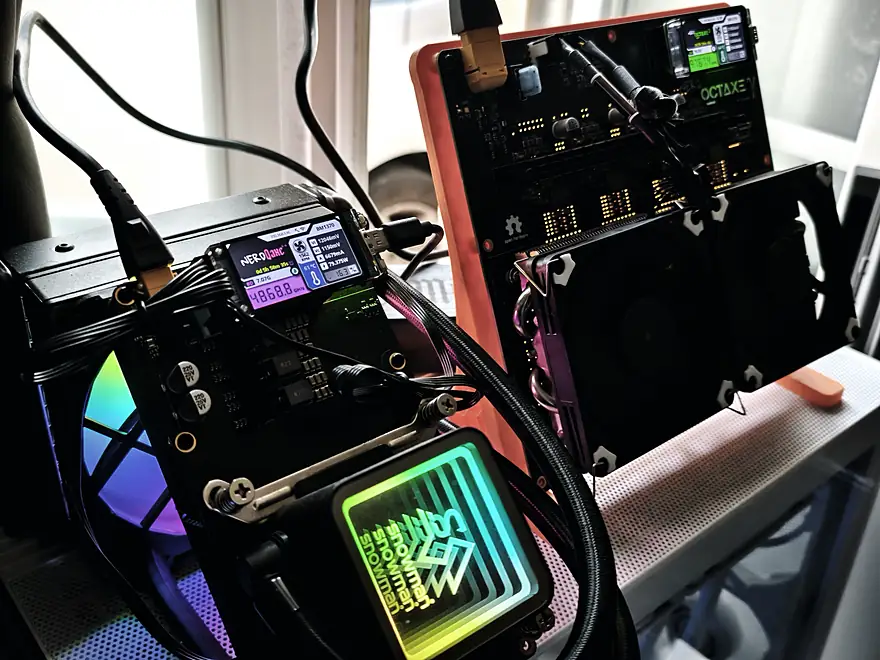
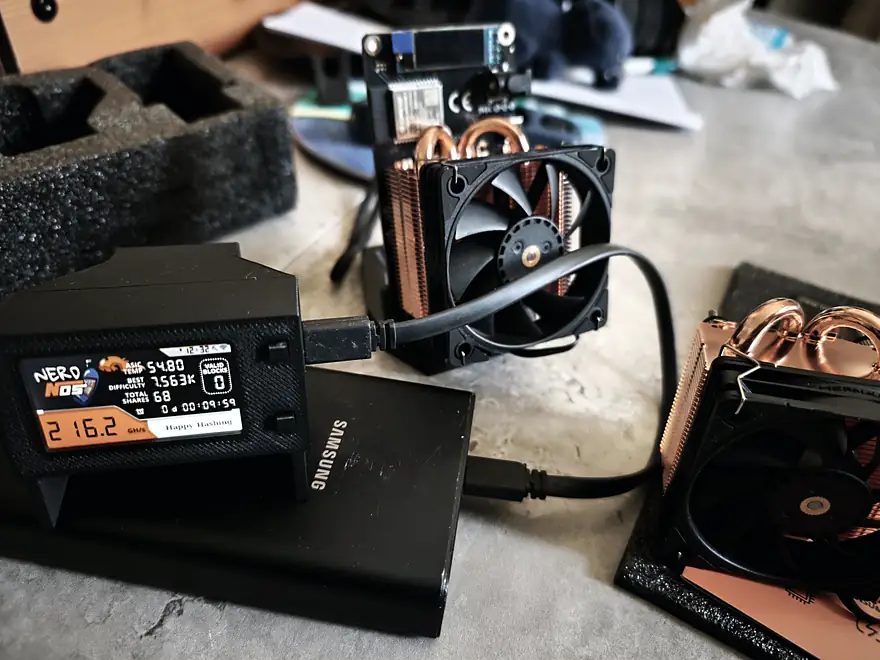
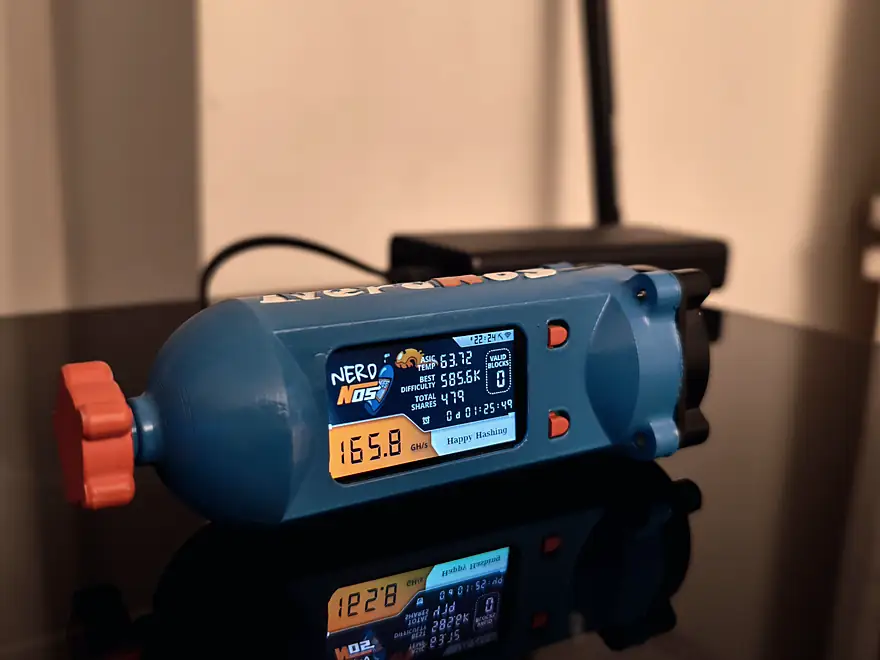
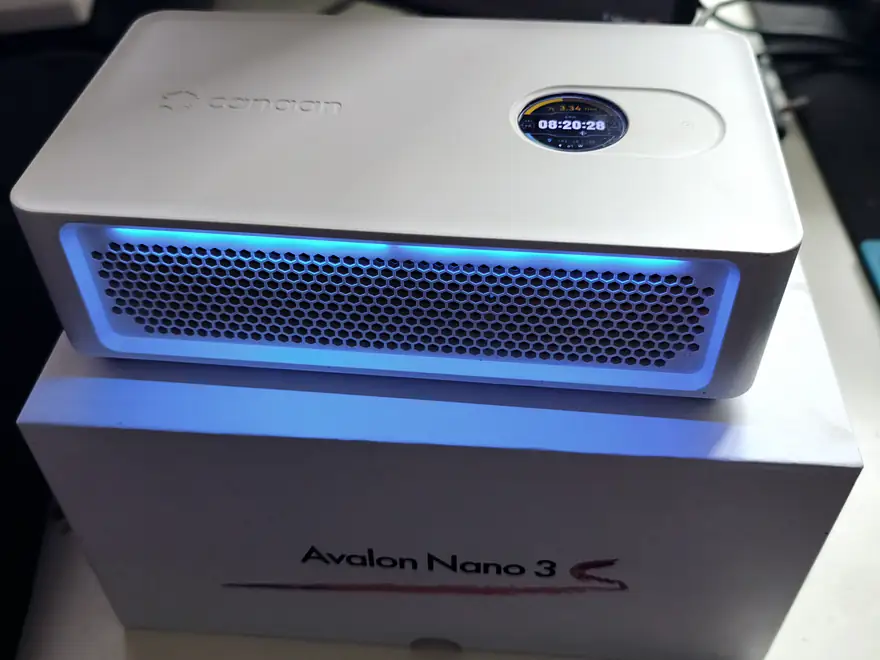
Not catalogue shots: my own gear, my own experiments and my own mess. Everything here has been in a video or in a build that went wrong.
The workshop is coming
I am putting together a place to offer what I make: stands, adapters, custom cases and cooling parts, designed for the various home mining boards. If that sounds useful, come and tell me, it will help me decide what to release first.
Got a question? Discord is fastest
Several of us answer there, and chances are somebody has already hit the same problem. I do not have every answer, but between us we usually work it out.
A WORD ABOUT FUNDING
I fund all of this myself. My tools are free, and they will stay free for as long as I am around. If you would like to support the work, the address is right there. Only if it makes you happy.
bc1p23zqga4jxvl09l4kpf0lxx8aprxmx2me8677h2nq3655jnh8qfnq7r2j0j